
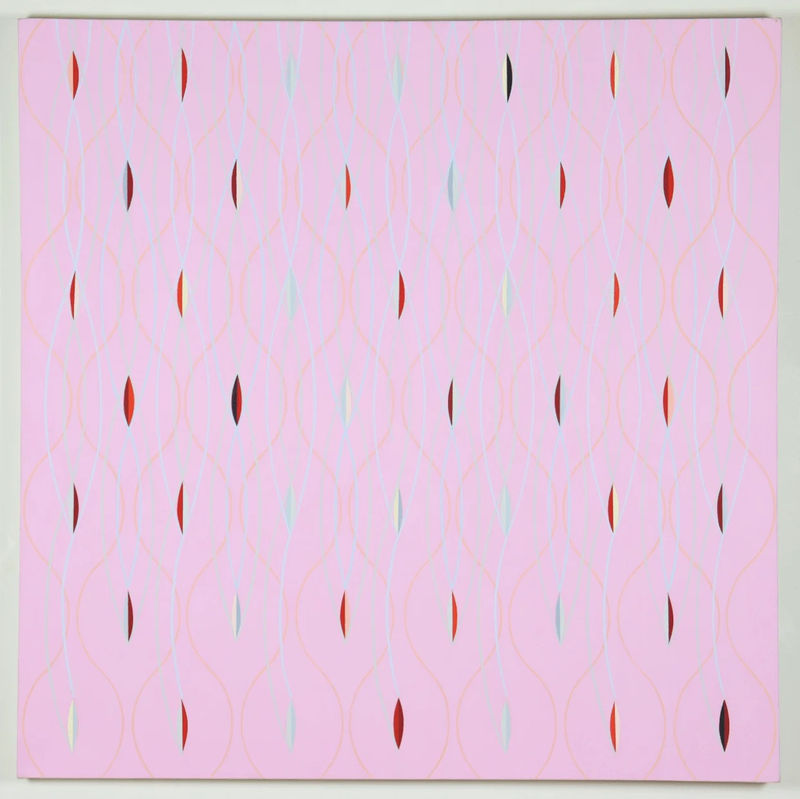
Born in Kaunas, Lithuania, Audra Skuodas spent six formative years in a displaced persons camp in Germany before immigrating to the United States in 1949. She became a U.S. citizen in 1961 and earned both her B.A. and M.A. from Northern Illinois University. Based in Oberlin, Ohio, she maintained a rigorous studio practice while raising a family and teaching at institutions including the Nova Scotia College of Art and Design, the Cleveland Institute of Art, and Oberlin College.
For more than fifty years, Skuodas worked assiduously, producing thousands of paintings, drawings, and artists’ books that are at once deeply personal and universal. In a text written for her 2023 exhibition at Abattoir, curator Emily Liebert explored Skuodas’ meaningful attachment to sewing and stitched work in the extensive Womb Wound series, linking it to an important autobiographical artist’s book composed of felt, photographs, and stitched designs. In an early assessment of her work, critic Donald Kuspit wrote, “Whatever suffering the figure may signify, it does so largely through the tense way it interacts with the rest of the picture, which is essentially geometrical.”
Skuodas was concerned with humanity’s place in the universe; its evolution and devolution, its capacity for sensitization and desensitization. This tension is central to her canvases, drawings, and especially her artists’ books. Her work resonates with the Japanese Zen Buddhist concept of satori: a moment of awareness in which the infinite and the finite become one. This symbiosis of image and text—of structure and intuition—guided both her work and her life.
Her work has been exhibited nationally and is held in prominent museum collections including the Akron Art Museum, the Allen Memorial Art Museum, and the Cleveland Museum of Art. In 2010, she was honored with the Cleveland Arts Prize Lifetime Achievement Award.